


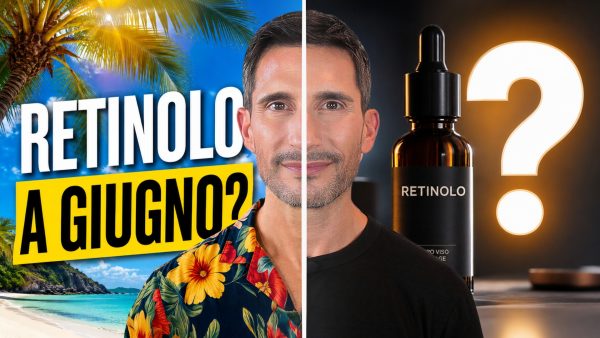
June arrives, the sun comes out, and widespread panic erupts on social media and in my comments section: “Doctor, should I stop using retinol now that I’m going to the beach? Am I going to get dark spots or burn my skin?”
This is perhaps the most common doubt when it comes to summer skincare, and every year, I see an alarming amount of misinformation online. Some suggest cutting it out drastically from May to October, while others claim you can safely apply it right under your beach umbrella.
The truth lies somewhere in the middle, but above all, it lies in the biology of our skin. Stopping retinol completely means losing months of progress against wrinkles, acne, and loss of elasticity. On the other hand, using it incorrectly risks hyperpigmentation and inflammation.
Let’s clear things up once and for all and look at how to manage this extraordinary active ingredient in total safety.
The Scientific Truth: Photosensitive vs. Photosensitizing
People often confuse these two terms, which sound similar but mean completely different things:
- Photosensitive: This refers to the stability of the molecule itself. Pure retinol is highly sensitive to sunlight. If it is exposed to UV rays inside a transparent bottle or right after you apply it to your face in the morning, it degrades and loses its efficacy. This means you are throwing your money away, not necessarily that you are staining your skin.
- Photosensitizing: This refers to a substance that, when exposed to the sun, triggers an immediate inflammatory or allergic reaction on the skin. Retinol itself is not a photosensitizing molecule.
So, why is it so feared in the summer? Retinol works by thinning the stratum corneum (the outermost layer of the epidermis where dead cells build up), while simultaneously stimulating collagen and elastin deep in the dermis to make the skin firmer. The stratum corneum and your tan (produced by melanin) act as your skin’s natural shield against UVA and UVB rays. By temporarily thinning this superficial shield, your skin naturally becomes more vulnerable to sun damage.
The solution? You don’t need to eliminate the ingredient; you just need to use common sense and proper protection.
The 6 Golden Rules for Summer Retinol Use
If your skin is already retinized (meaning it became accustomed to regular use during autumn and winter), here is how you should handle it:
1. SPF 50+ is Law
Applying retinol at night and failing to use a broad-spectrum SPF 50+ the following morning is out of the question. Use the two-finger rule for your face and reapply every two hours if you are outdoors. If you spend your day in an office or a medical practice without direct windows, continuous reapplication isn’t necessary, but there are no excuses for days spent outdoors.
2. Never Start in June
If you have never used retinol before, summer is not the time to start. Your skin needs time to adapt, and the initial stages can cause redness that, when combined with the summer sun, will inevitably lead to dark spots. However, if you are already using it, don’t stop: pausing for 4 months means resetting all the benefits you achieved during the winter.
3. Listen to Your Skin Barrier
Chlorine from the pool, salt from the sea, and sweat can irritate your skin. If you feel any burning or redness, pause your retinol for a few days. Just like you would adjust your diet during a stomach bug—listen to your body.
4. Lower the Concentration
If you use a high concentration of pure retinol (close to the maximum European limit of 0.3%) or stabilized derivative formulas in the winter, step it down for the summer. Switch to formulations with lower percentages (such as 0.1% or 0.2%) to keep your skin trained without stressing it.
5. Choose a Cream Texture (Instead of a Serum)
Serums penetrate the epidermis very quickly, which can increase the risk of irritation. Cream formulations, rich in soothing and hydrating ingredients like panthenol or glycerin, slow down the absorption rate of retinol, releasing it gradually throughout the night.
6. The “Sandwich” Technique or Using a Retinol Oil
If you are afraid of irritation, use the sandwich technique: after cleansing, apply a hydrating serum (with ceramides, ectoin, or peptides), follow with your retinol, and finish with another layer of moisturizer. Alternatively, complete your hydrating skincare routine and finish by patting a few drops of a retinol oil onto your face; the oily texture slows down penetration, making it highly tolerable.
The Emergency Plan for Holidays (Beach or Boat)
What should you do if you are going on a week-long boat trip or moving to the beach in August? Treat your skin exactly as we would in the clinic before a major medical-aesthetic treatment (like a laser or a strong peeling):
- Stop using retinol 3 to 4 days before leaving for intensive sun exposure.
- Enjoy your holiday by the sea while constantly applying SPF.
- Wait another 3 to 4 days after returning before reintroducing it into your nightly routine, giving your skin time to calm any underlying sun-induced inflammation.
The Botanical Alternative: Bakuchiol
If managing retinol causes you too much summer stress—and skincare should be a pleasure, not a source of anxiety—swap it out for Bakuchiol. It is a plant-derived alternative that mimics the regenerative effects of retinol but is non-photosensitizing, non-irritating, and can even be used during the day in total safety, preferably in hybrid or oil formulas at the end of your skincare routine.
See you in the comments: how do you manage your retinol in the summer? Have you paused it or modified your routine?
Warm regards,
Dr. Luis Campos