


Smoker’s Lines and Dark Spots Above the Lips: Causes, Active Ingredients, and Aesthetic Treatments
The perioral area is one of the most complex, expressive, and delicate anatomical zones on our face. While we frequently focus on eye contour care or refining the facial oval, the details around the mouth often reveal the first signs of skin aging and stress.
Two of the most common and stubborn issues in this area are vertical lines above the lip border (commonly known as “smoker’s lines” or “lipstick lines”) and hyperpigmentation on the upper lip zone (often referred to as a “shadow” or “dark mustache” effect).
In this article, we break down the biology and causes behind these skin concerns, explore the key active ingredients to look for in skincare, and examine when to turn to professional aesthetic treatments.
-
Smoker’s Lines: Why Do Vertical Perioral Wrinkles Form?
The Biological and Anatomical Causes
Vertical perioral wrinkles are not merely superficial creases; they result from a combination of structural and dynamic factors:
- Hypertonicity of the Orbicularis Oris Muscle: This is the sphincter muscle surrounding the mouth. Chewing, speaking, smiling, expressing, or smoking causes thousands of daily contractions that repeatedly fold the skin in the exact same spots.
- Loss of Dermal Density: As time passes, the skin naturally slows down its synthesis of type I and III collagen, elastin, and hyaluronic acid within the extracellular matrix. Consequently, the skin loses thickness and firmness, becoming less elastic.
- Bone and Fat Resorption: The involution of subcutaneous fat pads and gradual resorption of the maxillary bone reduce the underlying structural support.
Key Active Ingredients for Smoker’s Lines
Treating or preventing wrinkles in this delicate area requires more than a standard moisturizer—it demands high-penetration, restructuring molecules:
- Bioactive and Biomimetic Peptides: They function as “cellular messengers,” signaling fibroblasts to produce fresh collagen and proteoglycans to strengthen the dermal-epidermal junction.
- Redensifying and Tensing Complexes: Formulations containing lipo-dermal complexes and skin-density factors help restore the architecture of the dermis, offering a subtle, immediate smoothing effect.
- Multi-Molecular-Weight Hyaluronic Acid:
- High molecular weight: Retains surface hydration to prevent transepidermal water loss (TEWL).
- Low and ultra-low molecular weight: Penetrates deeper layers to hydrate the extracellular matrix and visibly plump fine lines from within.
- Epigenetic-Derived Molecules: Next-generation active ingredients capable of modulating cellular gene expression, slowing down aging processes, and reactivating the tissue’s natural regenerative capacity.
Aesthetic Medicine Solutions
When lines become static and deeply set, targeted aesthetic procedures can complement a dedicated skincare routine:
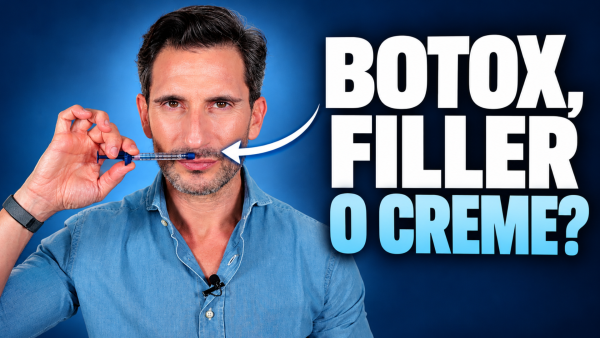
- Botulinum Toxin (Micro-Botox): Precisely calibrated micro-doses of botulinum toxin relax the hypertonic contraction of the orbicularis oris muscle without altering natural facial expressions or smiling.
- Hyaluronic Acid Dermal Fillers: Low-viscosity, highly integrative hyaluronic acids are injected along individual lines or the vermilion border to restore lost volume and structural support.
- Medical Microneedling: Unlike home rollers (which primarily aid product absorption), professional microneedling creates controlled micro-injuries that trigger a regenerative inflammatory cascade, stimulating endogenous collagen production.
- Laser Resurfacing and Microneedling Radiofrequency: High-energy technologies that induce thermal remodeling of aged collagen, promoting significant skin tightening and tissue restructuring.
-
Dark Spots Above the Lip: Post-Inflammatory Hyperpigmentation and Melasma
How Do Upper Lip Dark Spots Form?
Hyperpigmentation above the upper lip is one of the trickiest concerns to treat. It generally stems from two distinct mechanisms:
- Post-Inflammatory Hyperpigmentation (PIH): Very common after hair removal via waxing, plucking, or threading. Micro-trauma disrupts the stratum corneum and triggers an inflammatory response. Inflammatory cytokines signal melanocytes to produce excess melanin. If this irritated skin is exposed to UV rays (or visible light), the pigment fixes into the deeper layers, resulting in a dark mark.
- Perioral Melasma: Driven by a combination of hormonal, vascular, and genetic factors. Melanocytes in this region are hyper-reactive; even minimal exposure to heat or UV radiation can trigger melanin synthesis.
Key Active Ingredients for Upper Lip Dark Spots
To fade and prevent hyperpigmentation, a multi-target strategy is required:
- Salicylic Acid (BHA): Being lipophilic, it gently exfoliates pores and dissolves intercellular bonds (desmosomes) to accelerate cell turnover. It also possesses intrinsic anti-inflammatory properties, essential for shutting down the initial trigger of PIH.
- Tyrosinase Inhibitors: Active molecules that inhibit the key enzyme responsible for melanin synthesis (such as resorcinol derivatives, stabilized vitamin C, or azelaic acid).
- Barrier-Restructuring Ingredients: Niacinamide, ceramides, and skin-identical lipids help repair the protective barrier, reducing the skin’s reactivity to external stressors.
- Broad-Spectrum Sunscreen (SPF 50+ with UVA/UVB and Blue Light Protection): The non-negotiable step in any brightening protocol. Without strict daily sun protection, depigmenting treatments cannot deliver lasting results.
Dermatological and Medical Treatments for Dark Spots
- Medical Chemical Peels and Intensive Depigmenting Protocols: High-concentration acid peels and melanogenesis inhibitors that rapidly accelerate cell turnover and suppress pigment production at the source.
- Intense Pulsed Light (IPL) and Q-Switched / Picosecond Lasers: Energy-based treatments that selectively target melanin or vascular components to break down pigment clusters. Note: When managing melasma, thermal output must be carefully controlled to prevent rebound hyperpigmentation from heat.
-
Bonus: Cold-Weather Lip Care and Protection
Beyond the perioral skin, the lip mucosa itself needs extra attention during seasonal shifts. Lips lack sebaceous glands and a thick stratum corneum; as a result, they lose moisture up to three times faster than the rest of the face.
For colder months, look for lipid-replenishing lip treatments formulated with:
- Tissue Repair Factors and Ceramides: Essential for rebuilding a compromised skin barrier, especially for extreme dryness or flaking caused by harsh weather or drying medical treatments.
- Rubefacient and Micro-Circulatory Stimulants (e.g., Capsicum/Pepper Derivatives): Ingredients that temporarily increase blood flow to surface capillaries, delivering a natural, temporary plumping effect and a healthy flush.
In Conclusion
Treating the perioral area effectively requires consistency and an integrated approach. Identifying the precise underlying cause—whether structural volume loss or inflammatory hyperpigmentation—allows you to select the most targeted active ingredients for your routine and determine when to consult a professional for advanced aesthetic treatments.